


Understanding John 4:1-42: Jesus and the Samaritan Woman
“The woman’s mess becomes her message. Her heartbreak becomes the means by which other people give their hearts to Jesus.”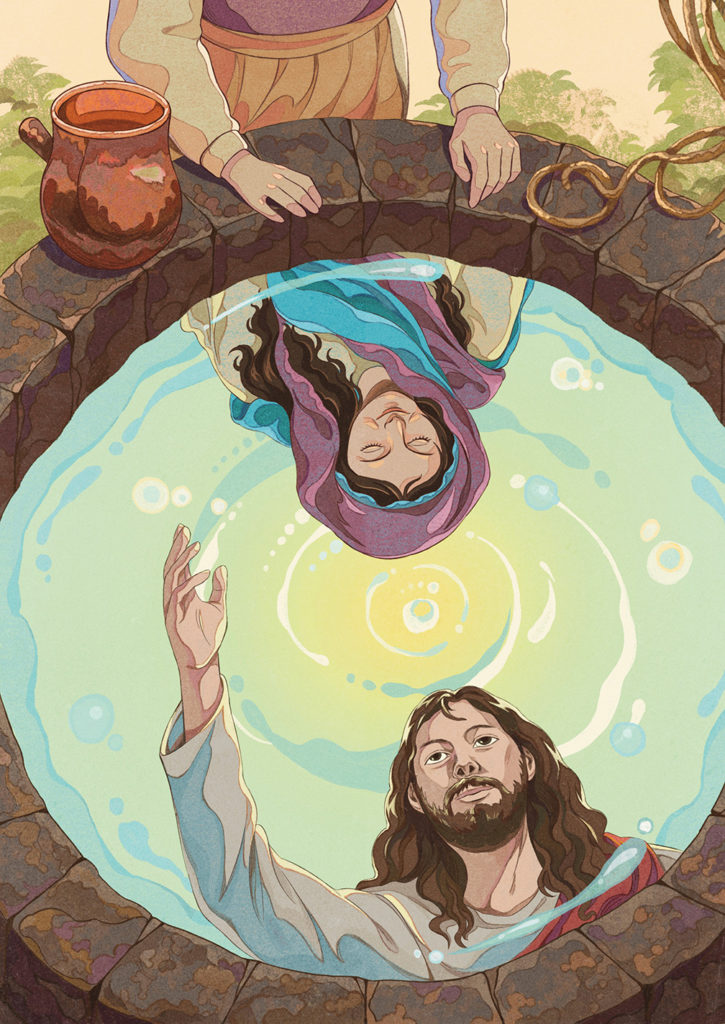
If the popular sitcom “Happy Days” reflects American social history, back in the 1960s the place for a guy to meet a girl was a drive-in diner. In the show, Arnold’s restaurant is the place where teenagers gather. Watering-holes as meeting places date back to the Bible. Isaac (Genesis 24:11-15), Jacob (Genesis 29:1-9) and Moses (Exodus 2:15-22) meet their future wives at a well.
When Jesus meets a woman at Jacob’s well (John 4:4), two social norms are clear: It is usual for a woman to collect water; it is unusual for a woman to talk with a strange man.
The conversation that unfolds is the longest recorded in the Gospels, but how have Jesus and the woman arrived there?
Jesus has been in Jerusalem for Passover (John 2:13). While there, he has overturned the tables of the Temple’s racketeering money changers and gotten into an argument with the authorities (John 2:14–21). People see His miracles and believe in Him (John 2:23). The Pharisees then hear that Jesus is gaining and baptizing more disciples than John (John 4:1). Although this is false intel (v 2), Jesus decides it’s time to get out of town (v 3).
Verse 4 (NIV 2011) records that “he had to go through Samaria.” This is unusual. There are three major routes from Jerusalem to the northern region of Galilee. At around 120 miles, the Mediterranean coast road is the longest. The King’s Highway via Jericho is around 100 miles long. The shortest (85 miles) is the Ridge Route through Samaria. If the “had to” in verse 4 means that Jesus is escaping the unwanted attention of the Pharisees, it is the ideal route: “Unclean” Samaria is a no-go area for devout Jews.
As a Samaritan, the woman has been brought up with double prejudice – her gender and her ethnicity. Samaria was once the center of the northern kingdom of Israel. In 722 B.C., Assyria invades, bringing foreign settlers and gods and wiping out Israel’s ethnic and spiritual purity.
After the southern kingdom, Judah, returns from Babylonian exile, Samaritans offer to help rebuild the Temple in Jerusalem. As the South no longer considers the North to be truly Jewish, they reject the offer, calling the North “the enemies of Judah and Benjamin” (Ezra 4:1-3 NIV 2011). In response, Samaritans build their own temple on Mount Gerizim and restrict their scriptures to the Samaritan Pentateuch – the first five books of the Old Testament.
Verse 9 (NIV 2011) explains that “Jews do not associate with Samaritans,” so when Jesus and the woman meet at Jacob’s well, they do so with personal baggage and cultural perceptions.
Jesus arrives tired (v 6) from His journey. The same Greek word for tired is used when Jesus offers rest to “all you who are weary” (Matthew 11:28 NIV 2011). This is understandable. Jerusalem to Sychar is about 44 miles with a climb-and-descent of some 9,000 feet. This is likely His third day of walking. He arrives at the sixth hour, which is noon (v 6). He is likely to have been walking for some five hours. It is April (all three Passovers in John’s Gospel are in April), so the mid-day temperature is probably in the 70s.
Jesus likely arrives hot, sweaty, smelly, aching, desperate for water and disorganised enough to have forgotten to bring a cup (v 11). The Messiah looks a mess.
Left by his food-seeking disciples, Jesus asks the woman for a drink (v 6-7). Instead of drawing water, she draws on 700 years of suspicion and prejudice: “You are a Jew and I am a Samaritan woman. How can you ask me for a drink?” (v 9 NIV 2011).
Instinctively, the woman follows culture and not compassion. She does not see Jesus as a person but as a problem. She labels him with “you’re one of them.” How readily do we see others as labels rather than as people?
As He looks at the woman, what does Jesus see? After offering her “living water” (v 10), Jesus asks her to call her “husband” (v 16 NIV 2011). The New Testament has no specialist Greek word for husband. The word widely used in the New Testament means man. Effectively, Jesus is saying “call your man.”
The conversation now focuses on the woman’s relationships with men (v 16-18). With five past relationships and living with a man who is not her husband, Jesus sees a woman whose life is messy.
Note, though, that Jesus does not tell her that she has sinned, as He does with the woman caught in adultery (John 8:11).
In that culture, the concept of a single, independent woman did not exist. A woman was always cared for by a man. Under the Mosaic Law that Samaritans observed, only men could initiate divorce proceedings (Deuteronomy 24:1-4).
There are, therefore, only two ways that this woman could have lost husbands – through death or divorce. Far from being a good-time girl, here is a woman who has been left and bereft time and again.
Jesus is not put off by the woman’s hard-hearted front. He sees past her defenses and cuts to the chase. He offers a “spring of water welling up to eternal life” (v 14 NIV 2011). He tells her how age-old prejudices will be a thing of the past (v 23). He explains the nature and inclusivity of true worship (v 24). When she says she believes the Messiah is coming, Jesus – in a rare disclosure – tells her that He is the Messiah (v 26).
When the disciples return, she heads back into town, recounts her conversation to folks and asks: “Could this be the Messiah?” (v 28-29).
Her in-depth encounter with Jesus has turned the woman into an evangelist. Because of her testimony, many Samaritans “believed in him” (v 39 NIV 2011). Jesus stays a further two days and “many more became believers” (v 40–41 NIV 2011). If she were the oft-portrayed woman of ill repute, would people have taken notice of her?The woman’s mess becomes her message. Her heartbreak becomes the means by which other people give their hearts to Jesus.
Likewise, we do not have to be perfect, pretend or prove anything to God. He knows, welcomes and values us. He uses us not in spite of our mess but because of our mess. After all, fewer people would be in the Kingdom of Heaven if the woman at well had been a well woman.
Jesus and the Samaritan Woman: John 4:1-42
Jesus knew the Pharisees had heard that he was baptizing and making more disciples than John (though Jesus himself didn’t baptize them—his disciples did). So he left Judea and returned to Galilee.
He had to go through Samaria on the way. Eventually he came to the Samaritan village of Sychar, near the field that Jacob gave to his son Joseph. Jacob’s well was there; and Jesus, tired from the long walk, sat wearily beside the well about noontime. Soon a Samaritan woman came to draw water, and Jesus said to her, “Please give me a drink.” He was alone at the time because his disciples had gone into the village to buy some food.
The woman was surprised, for Jews refuse to have anything to do with Samaritans. She said to Jesus, “You are a Jew, and I am a Samaritan woman. Why are you asking me for a drink?”
Jesus replied, “If you only knew the gift God has for you and who you are speaking to, you would ask me, and I would give you living water.”
“But sir, you don’t have a rope or a bucket,” she said, “and this well is very deep. Where would you get this living water? And besides, do you think you’re greater than our ancestor Jacob, who gave us this well? How can you offer better water than he and his sons and his animals enjoyed?”
Jesus replied, “Anyone who drinks this water will soon become thirsty again. But those who drink the water I give will never be thirsty again. It becomes a fresh, bubbling spring within them, giving them eternal life.”
“Please, sir,” the woman said, “give me this water! Then I’ll never be thirsty again, and I won’t have to come here to get water.”
“Go and get your husband,” Jesus told her.
“I don’t have a husband,” the woman replied.
Jesus said, “You’re right! You don’t have a husband—for you have had five husbands, and you aren’t even married to the man you’re living with now. You certainly spoke the truth!”
“Sir,” the woman said, “you must be a prophet. So tell me, why is it that you Jews insist that Jerusalem is the only place of worship, while we Samaritans claim it is here at Mount Gerizim, where our ancestors worshiped?”
Jesus replied, “Believe me, dear woman, the time is coming when it will no longer matter whether you worship the Father on this mountain or in Jerusalem. You Samaritans know very little about the one you worship, while we Jews know all about him, for salvation comes through the Jews. But the time is coming—indeed it’s here now—when true worshipers will worship the Father in spirit and in truth. The Father is looking for those who will worship him that way. For God is Spirit, so those who worship him must worship in spirit and in truth.”
The woman said, “I know the Messiah is coming—the one who is called Christ. When he comes, he will explain everything to us.”
Then Jesus told her, “I am the Messiah!”
Just then his disciples came back. They were shocked to find him talking to a woman, but none of them had the nerve to ask, “What do you want with her?” or “Why are you talking to her?” The woman left her water jar beside the well and ran back to the village, telling everyone, “Come and see a man who told me everything I ever did! Could he possibly be the Messiah?” So the people came streaming from the village to see him.
Meanwhile, the disciples were urging Jesus, “Rabbi, eat something.”
But Jesus replied, “I have a kind of food you know nothing about.”
“Did someone bring him food while we were gone?” the disciples asked each other.
Then Jesus explained: “My nourishment comes from doing the will of God, who sent me, and from finishing his work. You know the saying, ‘Four months between planting and harvest.’ But I say, wake up and look around. The fields are already ripe[e] for harvest. The harvesters are paid good wages, and the fruit they harvest is people brought to eternal life. What joy awaits both the planter and the harvester alike! You know the saying, ‘One plants and another harvests.’ And it’s true. I sent you to harvest where you didn’t plant; others had already done the work, and now you will get to gather the harvest.”
Many Samaritans Believe
Many Samaritans from the village believed in Jesus because the woman had said, “He told me everything I ever did!” When they came out to see him, they begged him to stay in their village. So he stayed for two days, long enough for many more to hear his message and believe. Then they said to the woman, “Now we believe, not just because of what you told us, but because we have heard him ourselves. Now we know that he is indeed the Savior of the world.”
Illustration by Weston Wei | This article was originally titled “The Woman at the Well: When a Mess Becomes a Message” in the October 2026 issue of The War Cry.